


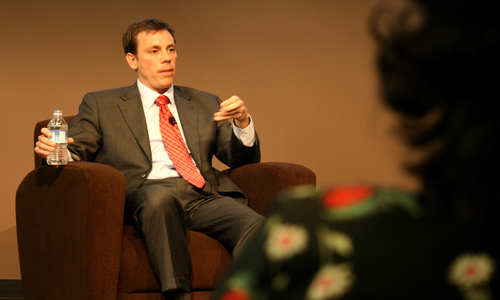
VandeHei cited both revolutionary new ways of practicing journalism as well as new media technologies like the iPad as the main reasons for his “bullish” outlook and confidence in the future of journalism.
As a former Washington Post political reporter, VandeHei now runs Politico with a primary focus on its Web content with a newspaper on the side, which was unheard of at the time of Politico’s conception and was very unlike the Washington Post.
“In the first half of 2006, 95 percent of the (Washington Post) newsroom saw the Web as a nuisance,” he said.
VandeHei said Politico’s focus on Web content and approaching the publication as a for-profit company has had a great effect on Politico’s success in actually turning a profit and has “flipped traditional journalism on its head.”
Digital journalism freshman Kevin Keller said VandeHei’s business-like approach to journalism gave him peace of mind.
“It’s promising that even when Facebook and Twitter aren’t making money, he’s making money doing political reporting,” he said.
Publishing interesting and captivating stories is also a valued goal of the publication, VandeHei said, adding that he felt the Washington Post was not fully aware of the content desired by the consumer.
“(There was a) disconnect between what we wrote and what people read,” he said. “The stories we put the most emphasis on were not the stories that ended up getting the most hits or being e-mailed the most.”
VandeHei said providing 360-degree coverage on a political issue as a service to the reader is no small task.
“We are obsessed with winning the morning, noon, and evening (readerships),” he said.
“We are a sweatshop. We have a different metabolic rate than the Washington Post.”
Even though providing consumers with thorough content is critical, VandeHei said that new advertising techniques will be the industry’s saving grace and the iPad is a great place to start.
“Effective advertising is going to save our industry,” he said, adding that the iPad is “the best thing that’s happened (to advertising). It’s the first time I’ve seen anything mobile that is like reading the newspaper.”
While VandeHei said the portability of the device is its crown jewel, the vividness and “pop” of the advertisements on the screen help advertisers justify spending money on ad space for online publications.
Broadcast journalism freshman Arielle Hurst said VandeHei’s optimism for the profitable future of the industry was refreshing.
“It was nice to hear that someone out there believes that people will pay for quality journalism in the future,” she said.
Contact the reporter at cullen.wheatley@gmail.com
