


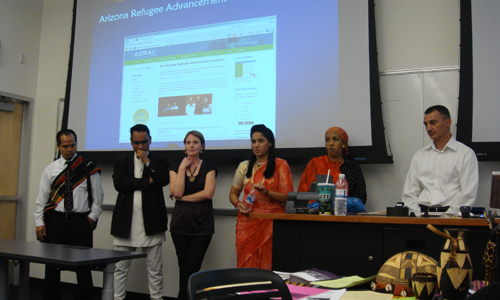
About 40 people attended the discussion, which was led by Joanne Morales, director of Refugee Programs for Catholic Charities, an organization that helps hundreds of refugees in Phoenix start new lives.
Morales said the discussion, which was the finale to the School of Letters and Sciences’ Humanities Lecture Series for the fall 2009 semester, was meant to inform students about the refugees who become members of the Phoenix community.
The discussion “allows us to open students’ eyes about what’s going on in the world, what some of the global issues are and to put a face to some of those conflicts and a face to how our community is welcoming those people,” she said.
Morales, whose husband is an asylee from Cuba, said she became interested in working with refugees after serving in the Peace Corps from 1999 to 2001.
“Refugees are individuals with a lot of strength and resilience who have had a lot taken away from them, but once they’ve been resettled, they have so much to give to strengthen our community,” she said. “It’s a blessing to work with them.”
One of the speakers at the discussion was Mohammed Abbas, 35, of Iraq, who was able to come to the U.S. after receiving a special immigration visa for serving as a translator and cultural advisor for the U.S. Army for 5 years.
Abbas, who arrived in Phoenix in late June, said he came to the U.S. with a dream just like everyone else.
“To find a good job, to educate myself (and) my family and to have a better opportunity than … back home,” he said.
Abbas, who came to Phoenix with his wife and 4-year-old son, said he has been surprised by but also really likes the democracy, the peace and the entire system of the U.S. He said he especially appreciates having individual rights.
“You’re on your own,” Abbas said. “You’re untouchable unless you make a mistake. Nobody can come and approach your house, nobody, not even the police.”
Abbas said he feels safe in the U.S. even when he goes out at night, while in Iraq he felt the police were malicious and not there to serve the people.
“911 for me is magic,” he said. “I enjoy being outside without my gun with me all the gun that I have is my phone.”
And though Abbas said he has enjoyed his life in the U.S., he also said there have been times when people acted differently around him because he is Muslim, including once when he got lost in a mall and asked for directions.
“I tried to talk to white people and they just got scared,” Abbas said. “They could tell that (my family and I) were Muslim, so they just come careful and cautious.”
Abbas tried to erase misconceptions about Iraqi people and told the audience they are hard workers who respect the law and want to contribute to their communities.
“The majority of Iraqi people who live in Iraq really want peace for their country,” he said. “They want democracy for their country.”
Nicole Moore, a criminal justice and criminology sophomore, said the most interesting part of the discussion was learning about each of the guests’ different cultures.
“Some of these cultures I never even knew of or never even heard of,” she said. “I’m fascinated with different cultures.”
Moore also said she did not know there were so many programs offered to help refugees in Arizona, which has five other organizations like Catholic Charities.
“All the services that we offer to them I didn’t know that it was 100 percent federally funded,” she said. “I thought most of it was from donations, so I’m glad we do give opportunities to refugees to come here and have a better life because a lot of (refugees) are still waiting.”
Moore said she encourages other people to come out to events like this one.
“A lot of people discriminate or don’t take the chance to take part in other cultures because they’re either afraid or (because of) what the media portrays,” she said. “I think it’s sad because there’s so many different cultures and opportunities in so many other countries that we never explore.”
As for Abbas, he said the biggest challenge he’s faced so far has been finding a job. He said in the U.S. people need to be certified to perform most jobs while in Iraq they simply need the skills necessary to perform any job.
However, Abbas said he will do what it takes to make sure his son gets the most of the opportunity given to him and his family, starting with enrolling him in school.
“I don’t want him to go through what I went through,” he said. “I will try to raise him differently. Not because we were raised wrongly, no, but there are things that my parents couldn’t provide for myself and I would like to provide for my son.”
“Do double-shifts, get two jobs, I don’t care,” he said. “I’m working very hard for my son.”
Contact the reporter at salvador.rodriguez@asu.edu
